Gateway Cloning
What is Gateway Cloning?
Biological context
Gateway Cloning was developed by Invitrogen and it relies on a modified version of a phage recombinase. Phage recombinases work like this:
- In nature, the phage genome contains a longer recognisition site attP that can be recombined with a shorter recognition site attB found in host genomes by a recombinase, leading to the integration of the phage genome into the host genome.
- This is similar to Homologous Recombination, but rather than relying on long homologous sequences, it uses shorter recognition sites.
- These sites have a short common part (represented by the white box with a circle in the cartoon), but the flanking regions are different
- After recombination, the resulting sites flanking the integrated fragment have sequences resulting from the combination attB + attP and attP + attB respectively, and are called attL and attR.

Gateway Cloning
Gateway Cloning relies on:
- Two modified versions of the phage recombinase that perform either the reaction equivalent to the integration (BP Clonase) or the reaction equivalent to the excision (LR Clonase).
- A set of modified att sites that include a number in their name, which can only be recombined with sites with the same number. For instance, attB1 can only be recombined with attP1, giving rise to attL1 and attR1. attB2 can only be recombined with attP2, giving rise to attL2 and attR2, etc.
- A set of specialised plasmids that have been designed for modular cloning.
Cloning with gateway involves three steps:
- Designing primers to amplify your sequence of interest to include attB sites.
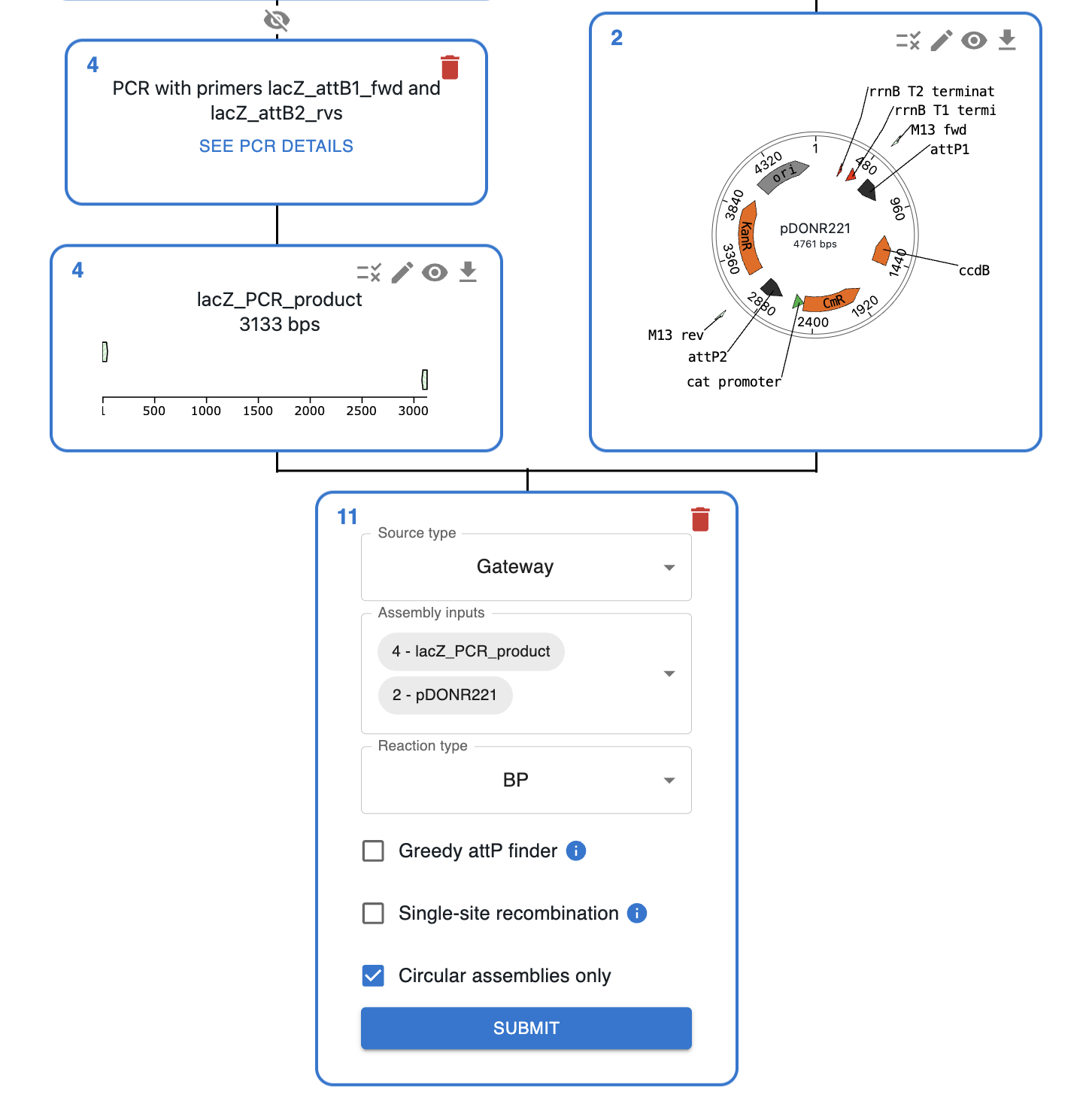
- Do a BP reaction to integrate that sequence into a donor plasmid, producing a plasmid termed "Entry Clone".
- Do an LR reaction, which recombines the "Entry Clone" with a destination vector, producing a plasmid termed "Expression Clone". The LR reaction can also integrate multiple sequences into the destination vector in what is known as a MultiSite Gateway.
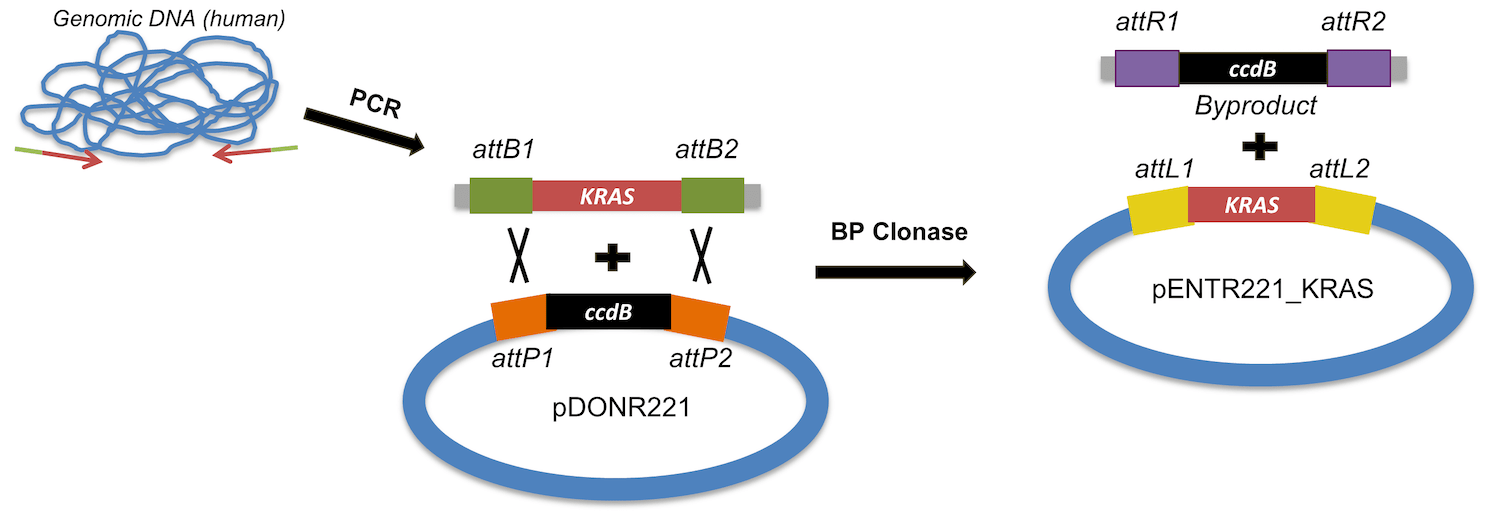
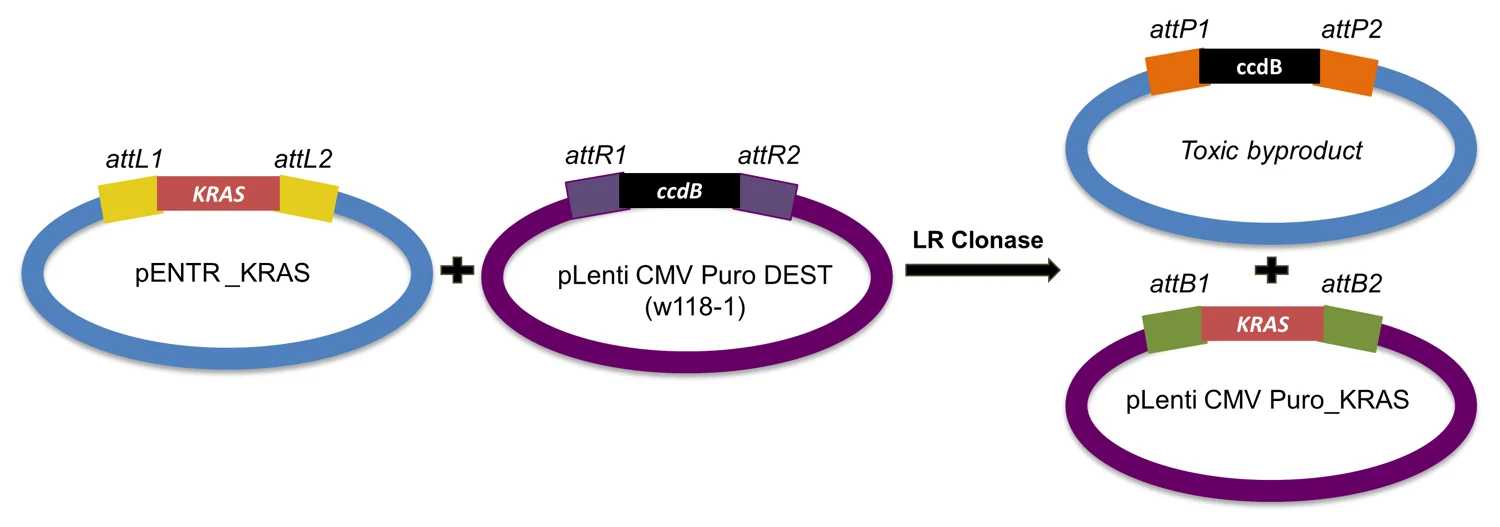
Think of the BP reaction as a domestication step, similar to the one for Golden Gate, where you put your sequence in a plasmid that can then be recombined with many others. For instance, to incorporate different tags.
Want to know more?
This process is explained in more detail in this Addgene blog post and in this 15 minute video, which I highly recommend watching if you want to understand the underlying molecular mechanism.
How to plan Gateway Cloning using OpenCloning?
- Like any other cloning method, click on the plus icon below a sequence in the
Cloningtab and selectGateway. - Then, select the sequences to use in the
Assembly inputsfield. - For the BP reaction, select your PCR product and the donor plasmid.
- For the LR reaction, select all the "Entry Clones" and the destination vector.
- If you want to design primers with attB sites for Gateway Cloning, see Primer design.